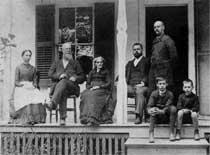
Alonzo's Watch is my first attempt at writing an audio drama. Six months ago, to borrow a phrase from Alfred Wheeler's letters, "I had no thought of it" but in April I received a letter from Jonathan Wilson, a distant cousin whom I had never met, inquiring about family history. Jon has made a hobby of documenting his genealogy and since our parents were first cousins he had a wealth of information about my family heritage that I was anxious to learn.
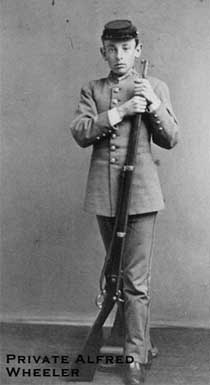
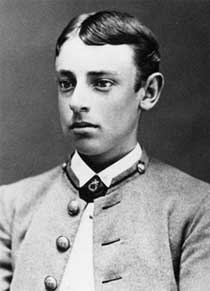
I heard stories as a child about a distant relative who ran away at a very young age, joined the Union Army and died in the Civil War. I was excited and intrigued to learn that Jonathan's branch of the family had kept a collection of letters which Alfred Wheeler sent home from the army. Among the first items he shared were two pictures of "Allie" in uniform and transcripts of the letters.
As I read the letters for the first time I became convinced that the story would make a great radio play. Still, the script most likely would never have been written if I hadn't mentioned the prospect to Joy Jackson. Her response: "You write it and we'll produce it." I knew the resources ART could bring to bear. This was the opportunity of a lifetime, so I had to try.
I sent the first draft to Joy over the Memorial Day weekend. I thought I was happy with that version until I received it back with some pretty major suggested revisions. The improvements she had wrought were amazing. I didn't accept every suggestion but many were included in the script that ART first began workshopping in June. ART members made suggestions of their own which helped improve subsequent drafts. And so it went. Joy became a full fledged co-writer and the ART members valued collaborators. Alonzo's Watch is as much their play as it is mine and I am grateful for their assistance and support.
Researching Alonzo's Watch
By Joy Jackson
Mike Wheeler found a branch of his family while doing an internet search early in 2005. He made contact with Jonathan Wilson, who sent him a digitized collection of letters from Alfred Wheeler, written in 1861-2. They had been saved by the family since 1862.
While Mike was working on building a framework for a radio play around Allie's letters, both he and I were researching the Civil War. Our first hits were the Internet: searching for First California Regiment, 71st Pennsylvania Regiment, Fair Oaks Battlefield, Ball's Bluff, Fortress Monroe, Antietam-anything that was mentioned in the letters. Both of us felt how important it was to keep the story true to the history.
Contracts were made and pursued with Civil War re-enactors in Washington, Kentucky and Michigan. We wanted the language to be believable for the time, and the right kind of background sounds. One of those contacts mentioned the Time-Life series of books called "Living Voices of the Civil War" -books using soldiers' letters. Particularly useful was A Soldier's Life.
A couple of us went to a Civil War re-enactment encampment, to gather ambient sound for the play, as well as talk about the project. The re-enactment community was very supportive, and willing to help out with anything. Many thanks to Bernie and Ted for being so welcoming and supportive.
Staff in libraries in Connecticut, Virginia, Kentucky and in Seattle answered questions which changed how the play would be developed.
It wasn't only the two writers who were learning about the Civil War-a number of ART's actors were also delving into the past. Allie's letters were passed from hand to hand, with a reverence seldom felt. Everyone involved wanted to do the best job they could for Allie. That the date for the premiere would be Sept 11 was all the more appropriate.